


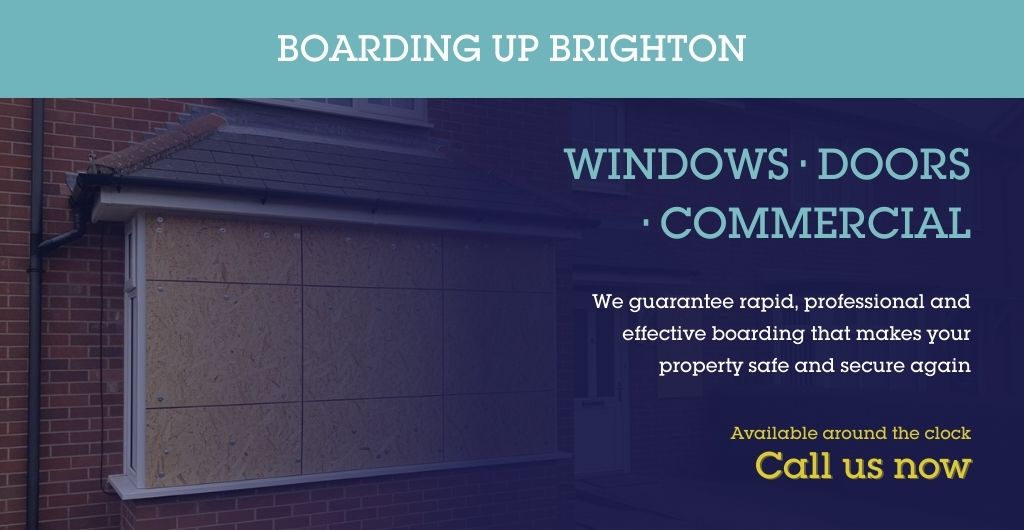
FAQs — Boarding Up Brighton (BN1–BN88)
When something goes wrong with a property—whether it’s a smashed sash window in a Brunswick Town flat, a damaged shopfront near Western Road, or a door forced in around Lewes Road—you usually need clear answers quickly.
Below are the questions we get asked most often about boarding up in Brighton and across the wider BN postcode area. If you’re dealing with an urgent security issue, visit our emergency boarding up page or call us directly.
Need help now? Call 01273 092 166 for immediate assistance.
Common questions about boarding up in Brighton
What is “boarding up”, and when is it needed?
Boarding up is the temporary securing of a vulnerable opening—most commonly a window, door, shopfront, or rooflight—using sheet materials (typically plywood or OSB) or specialist security products.
In Brighton and the BN area, it’s most often needed after:
- Burglary or attempted break-in
- Vandalism or accidental impact damage
- Storm damage (wind-blown debris, dislodged panels, broken glazing)
- Fire damage (once the fire service has made the scene safe)
- Flood damage where frames won’t close properly
If you want a plain-English overview before you decide, read what boarding up is and how it works.
Do you cover my area, or only central Brighton?
We cover Brighton & Hove and the wider BN postcode area (BN1–BN88). That includes central areas like Brighton, Hove, Kemptown and Portslade, plus surrounding towns and villages across Sussex.
You can check our full coverage on the areas we cover page.
Is this a 24/7 service?
We provide emergency call-outs, including evenings and out of hours, depending on availability and the urgency of the risk (for example, a ground-floor opening after a break-in).
We don’t quote guaranteed arrival times because traffic, access, and active incident scenes (police/fire) can affect scheduling—but we prioritise genuinely urgent jobs. For urgent help, use 24 hour emergency boarding up in Brighton.
What should I do first after a break-in or vandalism?
If there’s any danger or the intruder may still be nearby, call 999 immediately. If it’s safe and the incident has already happened, call 101 to report it and get a crime reference number.
Practical steps that help (when safe):
- Don’t touch damaged doors/windows more than necessary (it can be useful for police/insurers)
- Take a few quick photos for your records
- Call your insurer early to confirm what documentation they need
- Arrange securing/boarding to prevent further loss or weather damage
If this is your situation, the most relevant guidance is on burglary repairs and boarding up and vandalism repair and boarding up.
Can you board up tonight?
Often, yes—particularly for high-risk openings like street-facing shopfront glazing, a forced door, or a smashed ground-floor window. The key factors are safety (e.g., broken glass, structural stability) and access.
If you’re unsure, call and explain what’s happened. Need help now? Call 01273 092 166.
Materials, methods & what we install
What materials do you use—plywood or OSB?
It depends on the opening, the risk level, and how long it needs to be secure.
Common options include:
- 18mm exterior-grade plywood for strong, durable window/door boarding (typical for higher-risk openings)
- OSB (often 11–12mm) for smaller or lower-risk openings where appropriate
- Anti-tamper fixings where removal from outside is a concern
- Temporary steel doors for damaged entrances that need reliable medium-term security
For more detail on specific applications, see window boarding in Brighton and door boarding in Brighton.
Will you screw into the frame or brickwork?
We choose fixing methods based on the opening and the goal (security vs minimising damage). Where possible, we use methods that are secure but avoid unnecessary harm to surrounding frames and masonry.
If the frame is badly damaged (common after forced entry), non-destructive fixing may not be possible. In those cases, we’ll explain the options before proceeding, because there’s a balance between “minimal additional damage” and “properly secured”.
Do you board up from the inside or the outside?
It depends on access and security. Internal boarding can reduce external tampering in some setups, but it’s not always possible (for example, if the property is unsafe to enter or access is restricted).
For shopfronts and street-facing windows around busy areas in Brighton—think Western Road, London Road, or the seafront—external anti-tamper methods are often appropriate because the priority is preventing entry quickly.
Can you secure a damaged door without boarding it?
Yes, in many cases. If the door leaf, frame, or lock area is compromised, boarding alone can be an awkward short-term fix—especially if you need controlled access for trades, tenants, or insurers.
A temporary steel door can be a better solution for medium-term security, particularly for:
- Vacant properties
- Fire-damaged entrances once safe
- Repeated targeted break-ins
If you’re managing an empty building, see vacant property boarding and security.
Do you provide security screens as well as timber boarding?
We can advise on longer-term options where repeated incidents are likely or the property will remain empty. Security screens can be useful for void properties and some commercial sites where you need ventilation and visibility while preventing access.
If you’re unsure what’s suitable, call us and we’ll talk through your priorities (security, appearance, duration, access).
Commercial & residential questions
Do you board up shopfronts and commercial glazing?
Yes. We regularly secure commercial units, including shopfront glazing and vulnerable rear access points.
Commercial work often needs:
- Larger boards and stronger fixings
- Consideration of public safety (footfall, shards, sharp edges)
- Clear documentation for insurers or facilities teams
Read more about shopfront boarding in Brighton and commercial boarding up.
Can you help landlords, letting agents, and facilities managers?
Yes. We frequently work with landlords, agents, and facilities teams across Brighton & Hove and the BN area—especially for:
- End-of-tenancy voids
- Post-eviction security
- Repeated vandalism at empty sites
- Storm-damaged communal windows/doors
We can supply practical paperwork such as itemised invoices and a brief statement of works, plus time-stamped photos where appropriate.
Do you work on flats, basements, and older Brighton buildings?
Yes. Brighton’s housing stock includes a lot of Victorian and Regency-era conversions, basement flats, and tall terraces—often with awkward access, sash windows, and communal entrances.
Access and parking can be the biggest challenge in central areas (especially around the one-way system, North Laine, and tight residential streets). If you can tell us about:
- Entry instructions (buzzers, key safes)
- Floor level
- Where the damage is (front/rear/lightwell)
…it helps us arrive prepared.
Can you board up a rooflight or skylight?
Yes, where safe access is possible. Rooflights and skylights can become vulnerable after storms or impact damage, and in coastal Sussex the weather can turn quickly.
Roof work may require additional safety planning. For specifics, see roof boarding in Brighton.
Insurance, pricing & paperwork
Is boarding up covered by insurance?
Often it can be, especially when it’s necessary to prevent further loss (for example, securing after a break-in or storm). Cover varies widely by policy and excess, so it’s best to check directly with your insurer.
We’re not loss adjusters and we can’t promise what your insurer will accept—but we can usually provide the kind of documentation insurers typically ask for (photos and itemised invoices).
More guidance is on insurance claims support.
What information do you need for an insurance claim?
Insurers commonly ask for:
- Photos of the damage (before and after, if safe)
- A description of the cause (break-in, storm, vandalism, etc.)
- A crime reference number (for theft/burglary)
- An invoice or receipt with a clear breakdown
If you have an incident number, keep it to hand. If the police have attended and requested you don’t disturb anything yet, tell us—sometimes we can secure without interfering with key areas, but it depends on the scene.
How much does boarding up cost in Brighton?
Costs depend on the size and type of opening, material choice, access, and urgency. A small upstairs window is very different from a large shopfront panel, and damaged frames can increase the complexity.
We don’t publish “one price fits all” figures because it leads to surprises. Instead, we’ll ask a few practical questions and quote accordingly.
For transparent guidance, visit boarding up pricing.
Do you provide receipts and invoices?
Yes. Customers typically receive:
- An itemised invoice
- A brief description of works completed
- Photos (often time-stamped) where useful/appropriate
If you’re a business, landlord, or managing agent and need purchase order details included, mention it when you call.
Safety, access & practicalities
Is it safe to stay in the property after boarding up?
Boarding up improves security, but it doesn’t automatically make a property “safe to occupy”—particularly after fire, flood, or structural impact.
If there are concerns about electrics, gas, water ingress, or structural stability, you may need a qualified trade or the appropriate authority to confirm it’s safe. Our role is to secure the building envelope (reduce access and weather exposure).
For event-specific guidance, see:
- storm damage boarding and securing
- fire damage boarding and securing
- flood damage boarding and securing
- accident damage boarding and securing
Do I need to be at the property?
Ideally, yes—especially for residential jobs—so we can confirm access and agree the scope on arrival.
But we can sometimes work with:
- Key safes
- On-site security
- Letting agents/facilities managers providing access
- Clear written permission and contact details
If you can’t attend, call us and we’ll discuss the safest way to proceed.
Will boarding up damage my window frame or brickwork?
Any secure fixing method can leave marks, especially if the surrounding structure is already compromised. We aim to keep additional damage to the minimum needed to make the opening secure.
If you’re planning a proper repair soon, tell us—sometimes we can choose a method that’s easier to remove cleanly later, provided it still meets the security need.
How long does boarding up take?
It varies. A straightforward window can be quick; large or awkward openings (shopfronts, high-level windows, rooflights) take longer due to cutting, safe access, and fixings.
We’ll give you a realistic expectation on the phone once we understand:
- The number of openings
- Approximate sizes
- Whether glass is loose/dangerous
- Whether access is clear
Choosing the right service
Which service do I actually need: window, door, shopfront, or roof boarding?
Most callers describe the problem rather than the service (“the patio doors have been kicked in”, “the shop window has gone”, “there’s a hole in the roof”).
As a rule:
- Broken glazing / cracked panes → window boarding
- Forced entry / damaged locks and frames → door boarding or a temporary steel door
- Large commercial glazing → shopfront boarding
- Storm holes / rooflights → roof boarding
If you’re not sure, call and we’ll ask a few targeted questions to match the right approach.
Do you do the repairs as well, or just the boarding?
We specialise in securing properties—boarding and temporary security measures. We’re not glaziers, locksmiths, or builders, and we won’t pretend to be.
That said, good boarding up should make the repair stage easier by keeping the property weather-tight and secure while you arrange permanent works.
Helpful Links
- Emergency boarding up
- Boarding up pricing
- Insurance claims support
- Window boarding in Brighton
- Door boarding in Brighton
- Shopfront boarding in Brighton
Still got a question?
If you can tell us what’s happened and where (Brighton & Hove or anywhere in BN1–BN88), we’ll give straightforward advice on the best way to secure it.
Ready to get started? Call 01273 092 166 or email us for a free, no-obligation quote.
